Carbon Cycle Explained Simply
How carbon moves through Earth’s system — and why burning fossil fuels disrupts the balance
A Simple Starting Point
The carbon cycle is the system that moves carbon through the air, oceans, plants, animals, soils, and rocks. It’s one of Earth’s most important life‑support systems — and for millions of years, it stayed in balance. Only in the last 150 years has that balance been disrupted.
This page explains what carbon is, how the carbon cycle works, why it stayed stable for so long, and how human activities have overwhelmed it in a very short amount of time.
What Carbon Is (and Why It Matters)
Carbon is one of the basic building blocks of life. Every plant, every animal, every human cell contains carbon. But carbon doesn’t float around the atmosphere by itself. A single carbon atom is not a gas — it is a non‑metallic element that serves as a fundamental building block of matter. An element is a pure substance made of only one kind of atom, and it cannot be broken down into anything simpler by ordinary chemical means. Carbon, oxygen, hydrogen, nitrogen, iron, and gold are all elements.
Carbon becomes part of gases when it bonds with other elements:
- CO₂ (carbon dioxide) — one carbon atom + two oxygen atoms
- CH₄ (methane) — one carbon atom + four hydrogen atoms
These molecules are gases, and they move through the atmosphere, oceans, and living things as part of the carbon cycle.
CO₂ is especially important because it acts like a heat‑trapping blanket around Earth. A little CO₂ keeps the planet warm enough for life. Too much makes the blanket too thick.
How the Carbon Cycle Works
The carbon cycle is a loop — a continuous movement of carbon through different parts of Earth’s system.
1. Plants pull CO₂ out of the air
Through photosynthesis, plants absorb CO₂ and use the carbon to grow leaves, roots, and stems.
2. Animals eat plants
The carbon in plants becomes the carbon in animals.
3. Respiration returns carbon to the air
Plants and animals breathe out CO₂ as part of normal life processes.
4. Decomposition recycles carbon
When plants and animals die, microbes break them down, returning carbon to the soil and the atmosphere.
5. Oceans absorb and release carbon
The ocean takes in CO₂ from the air and stores huge amounts of carbon in water and marine life.
6. Rocks and sediments lock carbon away
Over millions of years, some carbon becomes trapped in rocks, sediments, and fossil fuels.
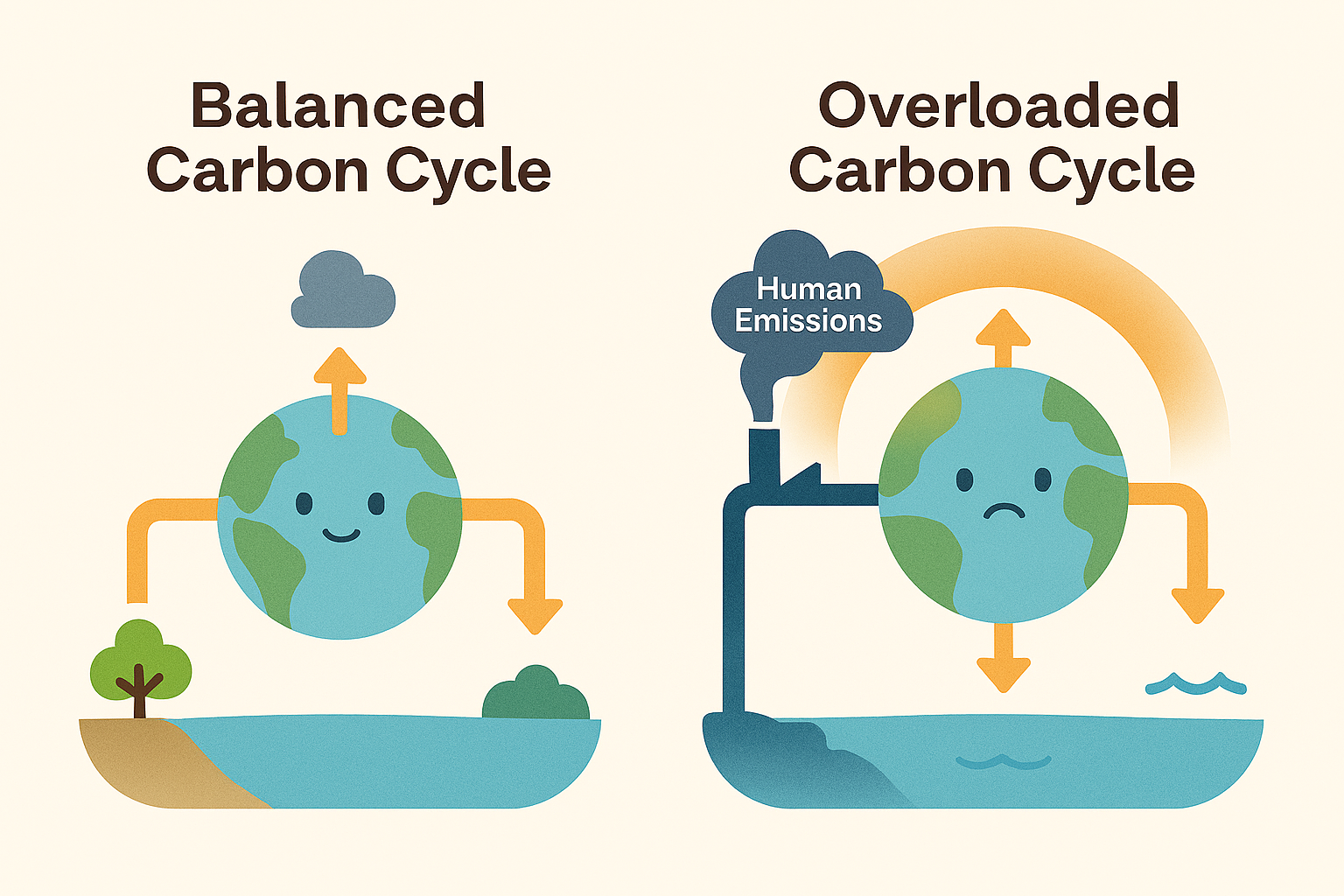
Balanced vs Overloaded Carbon Cycle — in a balanced cycle, Earth can release most excess heat into space; in an overloaded cycle, extra CO₂ thickens the atmosphere’s heat‑trapping blanket, causing more heat to be reflected back toward the surface instead of escaping.
A Stable Carbon Cycle Supported Life
For over 300 million years, Earth’s carbon cycle operated within a narrow range. CO₂ stayed around ~280 ppm, and the climate stayed stable enough for ecosystems — and eventually human civilization — to flourish.
Forests, soils, and oceans acted as natural stabilizers. They absorbed carbon when levels rose and released carbon when levels fell. The system adjusted slowly and predictably.
A key part of this stability was that huge amounts of carbon were locked underground, removed from the active cycle.
How Fossil Fuels Formed (and Why This Matters)
Hundreds of millions of years ago, vast amounts of plants, algae, and microorganisms died. They were buried under layers of sediment. Heat and pressure transformed this buried carbon into coal, oil, and natural gas.
This carbon was effectively taken out of circulation. It was no longer part of the active carbon cycle. That long‑term storage helped stabilize Earth’s climate for millions of years.
How Humans Disrupted the Carbon Cycle
About 150 years ago, during the Industrial Revolution, humans began digging up this ancient, buried carbon and burning it for energy.
Burning fossil fuels turns long‑stored carbon into CO₂ and CH₄, which go straight into the atmosphere. This re‑injected ancient carbon back into the active cycle at a pace nature cannot absorb.
Then, about 100–120 years ago, gasoline‑powered cars accelerated the process dramatically. Transportation became one of the largest sources of CO₂ worldwide.
The result: The carbon cycle became overloaded. The heat‑trapping blanket around Earth thickened faster than ever before.
Why the Cycle Can’t Keep Up
Nature removes CO₂ slowly: trees absorb it over decades, oceans absorb it over centuries, and rocks absorb it over thousands to millions of years.
Humans add CO₂ quickly: every car trip, every power plant, every industrial process.
The “ins” suddenly became much larger than the “outs.” The cycle is no longer balanced.
That’s why CO₂ levels have risen from 280 ppm → 420+ ppm in just 150 years — a change that would normally take tens of thousands of years.
What an Overloaded Carbon Cycle Means for Earth
When more carbon stays in the atmosphere, more heat stays trapped. That leads to:
- hotter days and more intense heatwaves
- warmer oceans and stronger storms
- shifting seasons and disrupted ecosystems
- melting ice and rising seas
- stress on agriculture, water supplies, and human health
These changes are not random. They are the predictable result of a carbon cycle pushed out of balance.
What Happens If Earth’s Carbon Cycle Gets More Out of Balance
When the carbon cycle becomes overloaded, CO₂ builds up faster than nature can remove it. If that imbalance continues to grow, the effects we’re already seeing become stronger and harder to reverse.
Several things happen as the imbalance increases:
- More heat becomes locked into the climate system, raising global temperatures further.
- Extreme weather becomes more intense, including heatwaves, storms, and heavy rainfall.
- Oceans continue to warm and acidify, stressing marine life and coral reefs.
- Ice sheets and glaciers melt faster, contributing to long‑term sea‑level rise.
- Ecosystems lose stability, making it harder for plants, animals, and human communities to adapt.
- Natural carbon sinks weaken, meaning forests and oceans absorb less CO₂ over time — which accelerates the imbalance even more.
These are not sudden “cliff events.” They are the predictable consequences of adding more carbon to a system that is already overwhelmed. The further the cycle drifts from balance, the more difficult and expensive it becomes to restore.
But the key point is this: the future is not predetermined. The carbon cycle responds to what we do next. The sooner we reduce the overload, the easier it is to stabilize the system and protect the conditions that support life.
What Accelerating Change Means for the Future
Climate change doesn’t always move in a straight line. Glaciers and ice sheets are melting faster than many earlier predictions expected, and some parts of the climate system can speed up once certain thresholds are crossed. These kinds of changes are hard to model exactly, which means future shifts could happen faster than today’s estimates suggest.
If the carbon cycle becomes even more unbalanced and warming continues to rise, these accelerating changes can reshape Earth in ways that are difficult for people and ecosystems to handle. Faster ice loss leads to faster sea‑level rise. Warmer oceans fuel stronger storms. Extreme heat becomes more dangerous. Forests, soils, and oceans — which normally help absorb carbon — can weaken under stress, making the imbalance grow even more quickly.
Over very long periods of time, if all major ice on Earth were to melt, sea levels would rise dramatically. Large areas where people live today would be underwater, and many of the systems we depend on — food, water, stable seasons, and healthy ecosystems — would face severe strain. Some people might still survive in certain regions, but life would be very different, and the pressures on human societies would be enormous.
These outcomes are not guaranteed. They represent what becomes possible if the carbon cycle is pushed further out of balance and accelerating changes continue unchecked. What actually happens depends on the choices humanity makes now and in the decades ahead.
How We Can Restore Balance
The carbon cycle can stabilize again — but only if we reduce the amount of ancient carbon we put back into the atmosphere.
- reduce fossil fuel use
- expand clean energy
- protect and restore forests
- improve soil health
- strengthen ocean protection
- develop technologies that remove CO₂ from the air
- coordinate global action
Every ton of CO₂ avoided or removed helps thin the heat‑trapping blanket and move the carbon cycle back toward balance.
Why We Are Still Hopeful
Even with the challenges we face, there are real reasons to believe we can restore balance to Earth’s carbon cycle. The situation is serious, but it is not hopeless. Humanity has solved enormous problems before, and we are already seeing signs of the same creativity and determination today.
One reason for hope is that we understand the problem more clearly than ever. We know how the carbon cycle works, why CO₂ is rising, and what needs to change. The science is not mysterious — it is straightforward, and the solutions are within reach.
Another reason is human ingenuity. Over the past century, people have created technologies that once seemed impossible: global communication networks, vaccines, renewable energy, electric vehicles, and more. The same creativity is now being applied to climate solutions, from better batteries to cleaner energy systems to new ways of removing CO₂ from the air.
Synthetic intelligence adds another layer of possibility. It can help design new materials faster, optimize energy use, improve climate models, and accelerate breakthroughs that would normally take decades. When human creativity and synthetic intelligence work together, progress can move much faster than before.
We are also seeing a shift in public awareness. More people understand the risks, more countries are investing in clean energy, and more companies are rethinking how they operate. Change is uneven, but it is happening.
The most important reason for hope is that the future is not fixed. Every fraction of a degree of warming we avoid makes a difference. Every ton of CO₂ we keep out of the atmosphere helps. The carbon cycle responds to what we do — and that means our choices still matter.
Hope is not about ignoring the risks. It is about recognizing that we still have the ability to shape what comes next.